
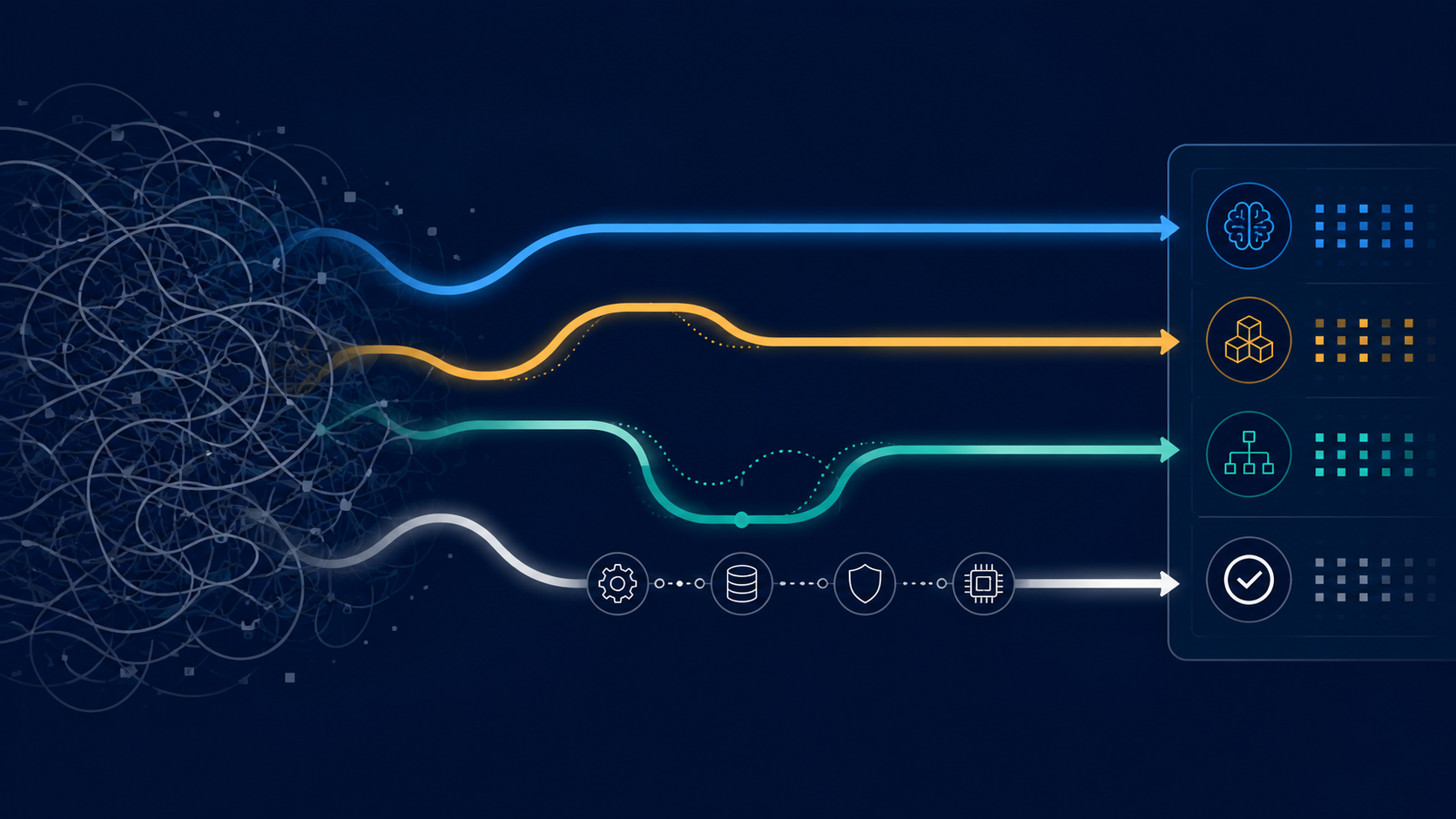
Real service and operations processes do not fail because of a lack of conversation. They fail because of a lack of structure to handle rules, exceptions, integrations, and operational continuity.
This realization is at the core of Zap2B's agentic playbook methodology. It did not come from theory, but from observing a recurring pattern: companies adopt AI agents, the agents answer well in simple interactions, but when the process requires logical sequence, context maintenance, and goal-oriented execution, the operation becomes fragile.
The problem is not the model. It is the lack of an operational structure that turns intent into reliable execution.
This article presents the methodology we created to solve that problem. It explains the concept of agentic playbooks, details the four flow types that organize the operation, and shows, through a real use case, how this structure sustains complex processes with predictability, control, and scale.
1. The real problem: why prompts are not enough
Most conversational AI solutions available today share the same simplified architecture: a well-written prompt, some persona instructions, a call to the model, and a response delivered to the user.
This works for one-off interactions. A customer asks for business hours, the agent answers. A visitor requests product information, the agent delivers. These are question-and-answer scenarios, with no state, no sequence, and no dependency between steps.
The problem arises when the process is complex.
A complex service process is not a list of questions the agent must answer. It is a logical sequence of interdependent steps, where each step depends on the result of the previous one, where business rules must be respected, where context must be maintained even when the user asks off-topic questions, where exceptions must be handled without interrupting the flow, where external tools must be triggered at the right moment, and where human team members must be involved without breaking the experience.
No prompt, no matter how well crafted, can sustain this level of operational complexity on its own.
The literature on LLM-based agents points in the same direction: agents are not just text generators. They are systems composed of perception, memory, planning, action, and evaluation modules (Wang et al., 2024). A prompt can start a conversation, but it cannot replace an operational architecture.
2. The limits of current approaches
Before introducing the playbook methodology, it is important to recognize why the most common market approaches do not solve the problem.
Isolated prompt engineering. Many teams try to solve operational complexity by expanding the prompt. They add rules, examples, constraints, and history. The result is a bloated, fragile prompt that is hard to maintain. Small process changes require rewriting large portions of the instruction. Long prompts also introduce context loss and information positioning problems (Liu et al., 2024).
Rigid fixed-flow automation. Another common approach is to build decision trees or fixed flows where each user question maps to a predefined answer. This works for very stable processes, but breaks at the first exception. Real users do not follow linear scripts. They ask questions out of order, change topics, and reverse decisions. Fixed flows cannot accommodate this unpredictability.
RAG without process coordination. Retrieval-augmented generation improves response quality by fetching information from external sources (Lewis et al., 2020). But RAG solves the information problem, not the operation problem. Knowing the price of a product is different from conducting a multi-step negotiation with validations and integrations.
The common thread among these approaches is that they all treat the agent as a responder, not as an operational executor. They focus on the quality of individual responses, not on the integrity of the process as a whole.
3. What is an agentic playbook
An agentic playbook is an operational structure that organizes how an AI agent should conduct a complex process from start to finish.
Unlike a prompt, which is a textual instruction to the model, a playbook is an organized set of flows that define:
- what the goal of the process is
- what the steps are to achieve that goal
- how each step should be conducted
- what to do when something goes off plan
- when and how to trigger tools, systems, or people
The playbook does not tell the model how to write. It tells the agent what to do and in what order.
This distinction is subtle but fundamental. In a prompt, instruction and execution are mixed together. In a playbook, the operational logic is separated from text generation. The model remains responsible for producing natural language, but the process structure is defined by the playbook.
It is this separation that enables the agent to operate complex processes without relying on a prompt that tries to predict every possible variation of a real conversation.
4. The methodology: four types of flow
Zap2B's methodology organizes agentic playbooks into four flow categories. Each has a specific function within the operation.
4.1 Main flows
Main flows represent the central progression of the process. They form the standard sequence of expected events for achieving the primary goal.
In a medical appointment scheduling process, for example, the main flows might be: initial reception, screening, time slot proposal, scheduling, and conclusion. Each represents a macro state of execution, and the transition between them is controlled by the completion criteria of each step.
Main flows are sequential by nature. The agent cannot skip steps or go back without a valid operational reason. This sequence is what ensures the process advances consistently, without gaps or unnecessary repetition.
4.2 Secondary flows
Secondary flows are support flows that can be triggered during the execution of a main flow without altering the macro objective of the journey.
They exist because, in real conversations, users rarely follow a linear script. During a scheduling process, the patient may ask about accepted insurance plans, consultation fees, or specific procedures. These questions are not part of the main sequence, but they must be answered without interrupting the scheduling progress.
The secondary flow allows the agent to answer the question, log the context, and return exactly to where it was in the main flow. Continuity is preserved because the main execution state is not lost when a secondary flow is triggered.
This mechanism solves one of the most common problems in conversational agents: the inability to maintain context when users ask questions outside the main sequence.
4.3 Exceptional flows
Exceptional flows handle situations that deviate from the main flow rules. They are triggered when a business condition, risk, eligibility criteria, or impediment requires a controlled departure from the standard path.
Examples include medical emergencies, unavailability of time slots, redirection to another service channel, or customer abandonment. Each of these situations requires specific treatment, with its own rules and defined outcomes.
Unlike secondary flows, exceptional flows temporarily or permanently alter the execution objective. In some cases, the agent returns to the main flow after handling the exception. In others, the exception completely redefines the path, ending the original process and starting a new one.
The existence of well-defined exceptional flows is what differentiates a robust agent from a fragile one. Without them, any off-plan situation causes the agent to hallucinate, get lost, or interrupt the service.
4.4 Operational flows
Operational flows sustain the playbook's operation without being part of the user-visible journey. They include integrations with external systems (CRM, calendar), memory and context logging, communication with the human team, and execution of internal processes.
These flows exist because an operational agent does not just converse. It must register the lead in the CRM, update the service status, notify the team about a pending issue, check calendar availability, and create a tracking ticket.
Operational flows separate service instructions from internal execution instructions. This keeps the playbook more organized, more readable, and more reusable, while allowing different teams — product, operations, engineering — to work on distinct layers of the process.
5. How the methodology sustains complex processes in practice
To illustrate how these four flow types work together, consider a medical appointment scheduling process at a clinic.
The agent receives the patient's first contact. The initial reception main flow is activated. The agent identifies the scheduling intent and directs the conversation to screening.
During screening, the patient asks about accepted insurance plans. The agent triggers the secondary flow for insurance questions, responds objectively, and returns exactly to where it left off in the screening flow, without losing progress.
At another point, the patient mentions a symptom that could indicate an emergency. The agent triggers the exceptional flow for medical emergencies, which interrupts the scheduling, guides the patient through the correct procedures, and, if necessary, alerts the human team.
When a time slot is confirmed, the operational flow for CRM and calendar integration registers the appointment, updates the lead status, and prepares the final confirmation.
In each of these moments, the agent knows exactly:
- what stage of the operation it is in
- what objective it needs to fulfill at that moment
- when to move to the next step
- when to handle an exception
- when to trigger tools or systems
- when to involve a human team member
The methodology does not treat the agent as a question-answering bot. It treats the agent as a process-driven operational executor.
6. What changes with this structure
Adopting the agentic playbook methodology produces concrete changes in the operation.
Predictability. The process has a clear path, with defined steps and controlled transitions. The team knows what the agent will do in each situation because the playbook describes the expected behavior.
Continuity. The agent maintains execution state even when contextual interruptions occur — parallel questions, exceptions, pauses. The patient does not have to restart the process because they asked an off-topic question.
Exception handling. Off-plan situations are handled in a controlled manner, with their own rules and defined outcomes. The agent does not hallucinate or interrupt the service when faced with the unexpected.
Agent-team integration. The human team can be engaged without breaking the experience. The agent logs the context, communicates the pending issue, and resumes execution when the team responds. No information is lost, and no rework is required.
Scalability. Because the operational logic lives in the playbook, not in the prompt, new processes can be modeled using the same structure. The methodology is replicable because it depends not on the specific content of each interaction, but on how the process is organized.
Governance. The separation between business flows, exception flows, and operational flows allows different stakeholders to work on the playbook. The product team defines business rules. The operations team monitors exceptions. Engineering maintains integrations.
7. Limitations and precautions
No methodology eliminates all risks. The agentic playbook approach requires awareness of certain limitations.
Modeling takes time. Creating a well-structured playbook requires process analysis, flow identification, exception mapping, and rule definition. For very simple processes, the modeling effort may not be justified.
Unmapped exceptions. No matter how thorough the modeling, there will always be situations that were not anticipated. The methodology reduces the impact of these exceptions but does not eliminate them. It is important that the playbook includes fallback mechanisms — such as escalation to the human team — for unmapped cases.
Playbook quality determines operation quality. A poorly structured playbook produces an inconsistent agent, regardless of the language model's quality. The methodology transfers part of the responsibility from the model to the process design.
Human supervision remains necessary. Not all decisions can be delegated to the agent. Operational flows involving human validation, critical decisions, or risk situations should keep supervision as part of the design, not as an exception.
The methodology does not eliminate the need for good data curation. Flows that depend on external system integrations are subject to the quality and availability of those systems. An outdated CRM or an offline calendar compromises the operation, regardless of the playbook's structure.
8. Conclusion
The agentic playbook methodology represents a paradigm shift in how AI agents are designed to operate complex processes.
It starts from a simple premise: the problem is not making the model answer better. The problem is giving it an operational structure that turns intent into reliable execution.
By organizing operations into four flow types — main, secondary, exceptional, and operational — the methodology creates a process logic layer that separates what to do from how to write. The agent stops being a responder and becomes a process-driven operational executor, capable of conducting journeys, handling deviations, triggering systems, and integrating teams.
This approach does not diminish the importance of language models. It repositions the model as a component within a larger operational system. The agent's quality comes to depend not only on the model, but on the quality of the structure that organizes its execution.
In a market where most solutions still treat AI agents as improved chatbots, the competitive difference will increasingly lie in the ability to structure operations — not in the ability to generate responses.
References
LEWIS, Patrick et al. Retrieval-Augmented Generation for Knowledge-Intensive NLP Tasks. Advances in Neural Information Processing Systems, 2020.
LIU, Nelson F. et al. Lost in the Middle: How Language Models Use Long Contexts. Transactions of the Association for Computational Linguistics, 2024.
WANG, Lei et al. A Survey on Large Language Model based Autonomous Agents. Frontiers of Computer Science, 2024.